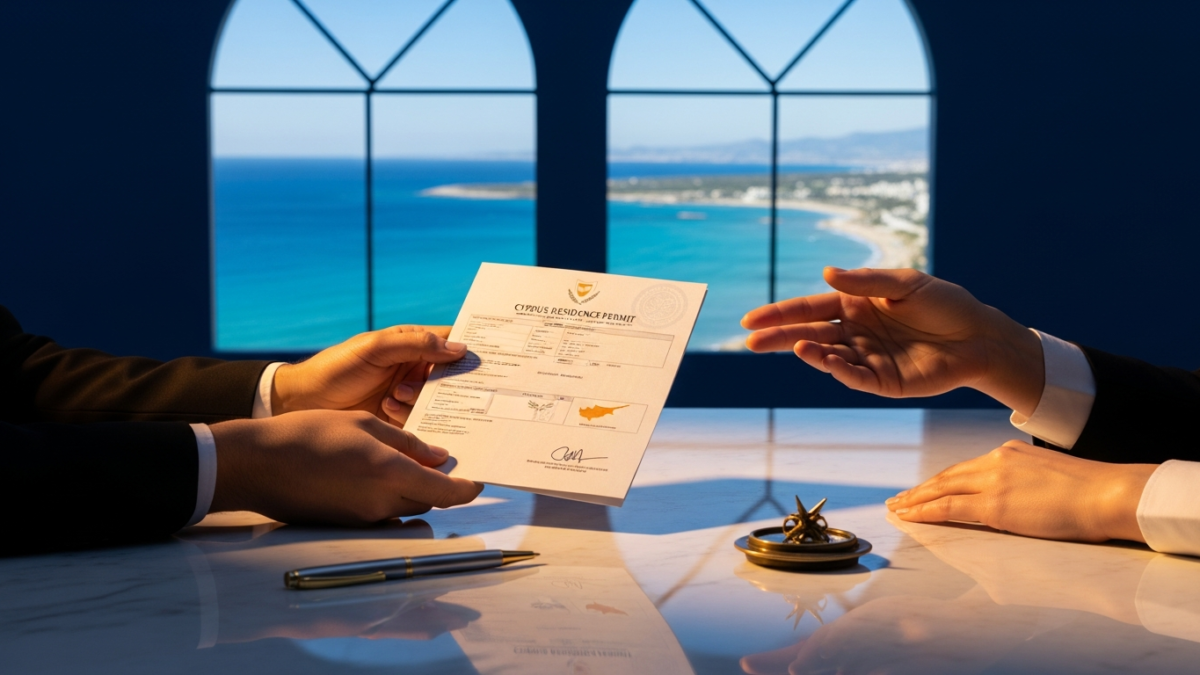
The Cyprus Golden Visa — formally the Fast-Track Permanent Residency Programme (Category 6.2) — grants non-EU nationals permanent residency rights in Cyprus in exchange for a qualifying investment of at least €300,000. It does not grant citizenship, and it is not the old citizenship-by-investment scheme (which was suspended in 2020). What it does provide is genuine, lifelong permanent residence rights in an EU member state, the ability to bring your family, and access to one of the most tax-efficient environments in Europe for high-net-worth individuals.
Key Takeaways
- Minimum investment: €300,000 + VAT in qualifying real estate or business
- Minimum annual income from abroad: €50,000 (plus €15,000 per dependent)
- Processing time: 4–6 months in practice; official target is ~2 months
- Permit is permanent — no renewal required as long as investment is maintained
- Covers spouse and dependent children on the same application
- Does not grant the right to work in Cyprus (separate work permit required)
- Path to Cyprus citizenship after 7 years of continuous legal residence
What the Cyprus Golden Visa actually is in 2026
The programme is governed by Regulation 6(2) of the Aliens and Immigration Regulations, which is why it is sometimes called the Category 6.2 permit. It has operated continuously since 2009, albeit in different forms. The current iteration — residency by investment rather than the citizenship-by-investment scheme that was suspended following European Commission pressure in 2020 — is a straightforward permanent residency permit with no expiry date, provided the qualifying investment is maintained.
It is important to distinguish this from the Digital Nomad Visa (temporary, for remote workers) and the EU Blue Card (for employed professionals). The Golden Visa is specifically for investors and high-net-worth individuals who want permanent residence rights without being employed in Cyprus.
The three eligibility requirements
1. Qualifying investment of at least €300,000 + VAT
The investment must fall into one of three categories: purchase of a new residential property (or two residential properties) from a developer for a combined price of at least €300,000 + applicable VAT; purchase of commercial real estate (offices, retail, hotel) for at least €300,000; or investment of at least €300,000 in a Cyprus company with operations and staff in Cyprus. The investment must be maintained throughout the lifetime of the permit — selling the asset and not reinvesting into another qualifying investment triggers permit cancellation.
Limassol is by far the most popular location for qualifying real estate purchases, driven by its strong rental yields, established expat infrastructure, and position as Cyprus’s commercial capital. For context on the property market, the current average for a qualifying new-build apartment in central Limassol is €320,000–€450,000.
2. Annual income of at least €50,000 from abroad
The applicant must demonstrate clean annual income of at least €50,000 originating from outside Cyprus. Acceptable sources include: foreign employment income, pension, dividends from foreign companies, rental income from properties outside Cyprus, or interest on foreign bank deposits. An additional €15,000 per dependent included in the application is required on top of the base €50,000.
3. Clean criminal record
Both the primary applicant and the spouse must provide a clean criminal record certificate from their country of origin and, if applicable, the country of current residence. This is a standard background check rather than an enhanced scrutiny process.
The application process
Applications are submitted to the Civil Registry and Migration Department of the Ministry of Interior. The process has four practical stages:
- Secure the qualifying investment. For a property purchase, this means signing a contract of sale and paying the purchase price in full (or at the contracted stage) before the immigration application is submitted. The payment must be traceable from a foreign bank account to a Cyprus account — cash transactions are not accepted.
- Prepare documentation. Required documents include: valid passport, title deed or contract of sale, proof of payment, evidence of annual income (bank statements, company accounts, or pension letters for the most recent year), criminal record certificates, and proof of health insurance. All documents in foreign languages require certified translation into Greek or English.
- Submit to the Migration Department. The application form (MEU7A for the main applicant, MEU7B for dependants) is submitted in person or via a Cyprus-registered lawyer. The lawyer route is strongly recommended — the documentation requirements are detailed and submission errors commonly cause delays.
- Biometrics and decision. The applicant and all dependants must attend a biometrics appointment in Cyprus. For applicants outside Cyprus at the time of application, a visa may be required for the biometrics visit (EU and many other nationals can visit visa-free). The official processing target is approximately two months from a complete application; practical timelines are 4–6 months in 2026.
Job hunting at work? We won’t tell. Try Busy Simulator — instant fake-meeting sounds so your screen looks deeply important.
What the permit gives you — and what it does not
The Cyprus Permanent Residency permit is exactly what it says: permanent legal residence rights in Cyprus. Specifically, it gives you:
- The right to live in Cyprus indefinitely without visa renewals
- The right to move freely in and out of Cyprus
- Access to Cyprus’s public healthcare system (GESY) after registration
- The ability to enrol children in Cyprus state schools
- A path to Cyprus citizenship after seven years of continuous legal residence (subject to language and integration tests)
It does not give you:
- The right to work as an employee in Cyprus (a separate work permit or EU Blue Card is required)
- The right to work or reside in other EU member states (Cyprus permanent residency is not EU-wide)
- Automatic tax residency (you need to spend more than 183 days per year in Cyprus, or meet the 60-day rule under the Non-Dom scheme)
The tax angle — why this matters for high-net-worth applicants
The Cyprus Golden Visa is frequently pursued in combination with Non-Domiciled (Non-Dom) tax status, which provides a complete exemption from the Special Defence Contribution on dividend income, interest, and rental income from outside Cyprus. For an investor with a foreign investment portfolio or business interests outside Cyprus, Non-Dom status can eliminate tax entirely on passive income for up to 17 years. Cyprus also has no inheritance tax, no wealth tax, and a capital gains tax that only applies to gains on Cyprus-situated immovable property.
Combined with the cost of living and quality of life in Limassol, this makes the programme genuinely competitive with Malta’s MRVP, Portugal’s now-restructured Golden Visa, and Greece’s Residency by Investment programme on a total-cost basis.
Browse current openings on our partner site jobs.com.cy — Cyprus’s largest job board.
Frequently asked questions
How much does the Cyprus Golden Visa cost in 2026?
The minimum qualifying investment is €300,000 + VAT (typically 5–19% VAT depending on whether the property is a primary residence). Government application fees add approximately €500–€2,000. Legal fees for a qualified Cyprus immigration lawyer typically run €3,000–€8,000 for the full process. Total all-in cost for a €300,000 property purchase: approximately €320,000–€340,000 plus ongoing annual income requirements.
Can I work in Cyprus with the Golden Visa?
Not automatically. The Permanent Residency permit grants the right to live in Cyprus but not to be employed. If you want to work for a Cyprus employer, you need a separate employment permit. As a business owner or investor, you can operate a Cyprus company (as director or shareholder) without a separate employment permit. See the Cyprus work permit guide for employment routes.
Does the Cyprus Golden Visa cover my family?
Yes. Your spouse and dependent children (under 18, or under 25 if in full-time education) can be included in the same application. Each additional dependent requires an additional €15,000 annual income on top of the base €50,000. Dependent adult children over 25 can apply separately on the basis of the same qualifying investment.
How long does Cyprus Golden Visa processing take?
The official target is approximately two months from submission of a complete application. In practice, processing in 2026 is running at 4–6 months for standard applications. Complex cases involving documentation from multiple jurisdictions or additional due diligence take longer. Engaging an experienced Cyprus immigration lawyer significantly reduces the risk of delays caused by incomplete documentation.
What happens if I sell the qualifying property?
The permit requires the qualifying investment to be maintained. If you sell the property and do not reinvest in another qualifying asset, the permit can be revoked. You must notify the Migration Department of any change to the qualifying investment. Reinvesting the proceeds into another qualifying property, commercial real estate, or business investment maintains the permit.
Can Cyprus Golden Visa holders apply for citizenship?
Yes, after seven years of continuous legal residence in Cyprus. The naturalisation application requires demonstrating integration (including basic Greek language ability at A2 level), clean criminal record, and continuous legal residence throughout the period. Cyprus citizenship confers full EU citizenship rights, including the right to live and work anywhere in the EU.